

Even Hermès buckled: down 14% in a morning, its worst level since January 2023
Sales in Dubai’s luxury malls collapsed by 40% in March. “January and February were double-digit growth. And then March was an abrupt halt.”
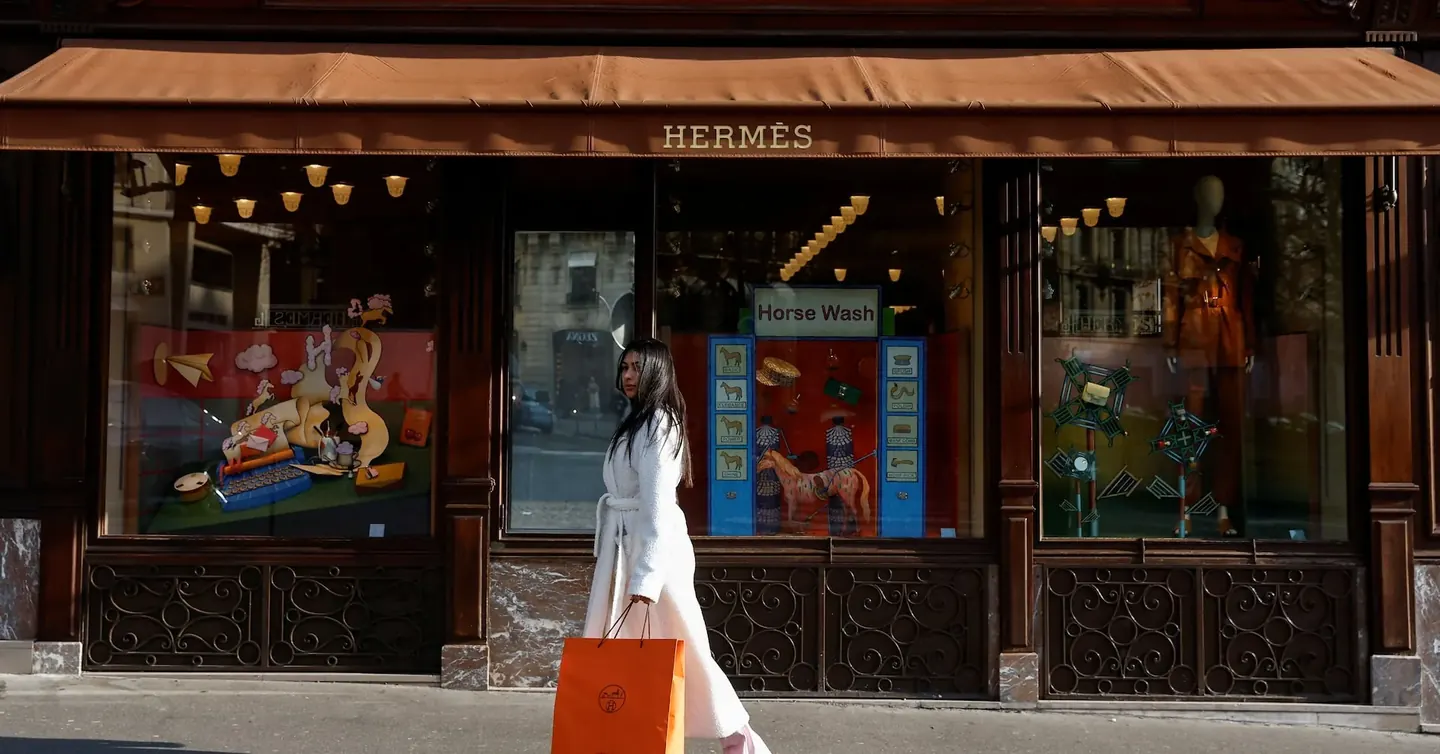
Hermès led a sell-off in luxury stocks: weak sales showed that the war in Iran is weighing both on Middle Eastern demand and on tourism in Europe. Hopes of a recovery in the sector took a knock.
Shares in the maker of the Birkin fell as much as 14% in early trading — to their lowest since January 2023 — then pared some of the losses to trade 9% down by 08:50 GMT. Losses for the year to date have reached 24%. Kering shares fell more than 9% the same day after it reported the war’s impact on spending, echoing LVMH, which said on Monday that the region had slowed sharply. Volatility in luxury stocks has been amplified further by hedge funds building positions in the sector.
Hermès, which tightly controls production and distribution in the interests of exclusivity, has been the most resilient player through the industry’s multi-year slump — and even it proved unprotected. First-quarter sales — handbags, silk scarves, fragrance — rose 5.6% at constant currency, below the Visible Alpha consensus of 7.1%. Analysts at Deutsche Bank noted that with prices raised 6% at the start of the year, this implies “zero organic volume growth” — the number of items sold did not increase.
According to chief financial officer Eric du Halgouët, the conflict cost the company 1.5 percentage points of quarterly sales growth. Sales in the Middle East region fell 6% at constant currency, to €160 million from €185 million a year earlier. “We had very good, double-digit growth in January and February, and then March was an abrupt halt,” he said, adding that sales in Dubai’s luxury malls and other Gulf hubs collapsed by 40% in March. The Middle East accounts for only 4.4% of sales — though last year it was Hermès’ fastest-growing region. The impact on margins is so far “immaterial”: “It will all depend on whether this lasts another month or two… If it is a two-month story, I think we can absorb the effect without much difficulty.”
A separate headache is the strong euro. It cost Hermès €290 million of revenue over the quarter, pushing reported sales down 1% to €4.07 billion from €4.13 billion a year earlier.
The house, which serves the ultra-wealthy with handbags priced above $10,000, said the drop in tourist traffic hit sales at concession stores in airports and in the Middle East, as well as in France, Britain, Italy and Switzerland, where Gulf shoppers are a key driver. In France, where du Halgouët said more than 50% of sales come from tourists, revenue fell 2.8%. In Asia, the largest region for Hermès, growth was only 3.5% at constant currency: disruption to air travel affected stores, particularly in Singapore and Thailand.
The bright spot was the United States, where sales rose 17.2% at constant currency.