

“I started with five pounds at my kitchen table”: Studio Nicholson takes to the runway
The British label broke through in Japan first and only then at home. Sixteen years on: a first Paris show and revenue up 56% in three years.
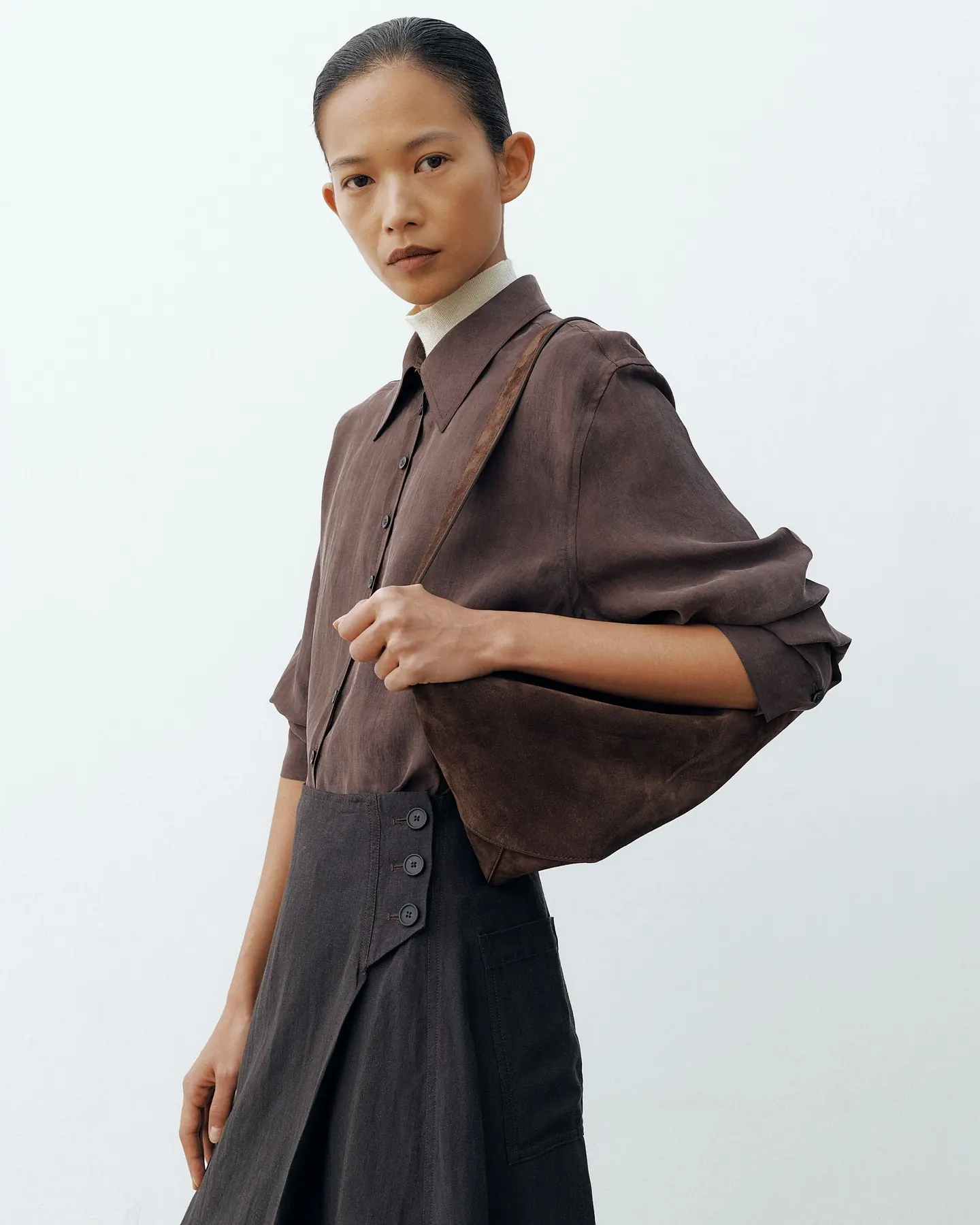
The London label Studio Nicholson is showing its first runway collection after sixteen years in business. It is part of a strategy to build authority and reposition the brand alongside the luxury giants in stores around the world.
The label’s path has been unconventional. Despite its British base, Studio Nicholson began its wholesale business in Japan, where founder and creative director Nick Wakeman drew her early ideas for the brand’s heavy workwear codes. Among the first buyers were Journal Standard and 1LDK. “We would not be alive without the Japanese,” she says. “It was a natural territory to start in.” Before that she co-owned the label Birdie with Kazuyoshi Minamimagoe, then buying director at the Beams chain. Unlike most cult Japanese basics brands, Studio Nicholson started with womenswear; menswear followed in 2017. Today the split is 55% men’s and 45% women’s.
In London, where wholesale began in 2010, things moved more slowly: buyers included the now-closed concept store The Shop at Bluebird, Liberty and small independents. “I don’t know, it’s a strange thing, but London has never been a big focus for me or for the brand,” Wakeman admits. The label is now building its presence in South Korea and China, as well as in Europe and the US.
The value proposition is straightforward: quality production at premium European factories and mills — and surprisingly reasonable prices. The cheapest item on the site today is a £20 tote bag; the most expensive is a £2,400 shearling bomber.
Since 2023 the strategy has been run by chief executive Mark Suddards, who previously helped Ganni grow from cult label into a global player; he joined as managing director in May 2023 and became chief executive in December 2024. “Our strategy right now is firmly built around how we take our niche east London brand and become a more global player,” he says. “How we really establish a position against the contemporary brands: Lemaire, Auralee. When you look at how much they invest in marketing and how they position themselves globally — of course they all show in Paris.”
The results so far bear out the choice. Between 2023 and 2026, Studio Nicholson’s revenue grew 56% on the back of category expansion. The average direct-sales basket runs between £450 and £500, and in the first seven months of the current financial year (which ends on 30 September) the brand grew 25% — putting it on course for another record. Over three years, direct retail sales through its London stores, its website and Farfetch rose 87% and wholesale 36%; over two years it added 200 new retailers, including Mytheresa, Bloomingdale’s and Selfridges.
The label works with the advisory firm Rianta Capital. “They came in in 2016 with a very small investment, and there has been no investment since,” says Wakeman; before that she was the sole director. “I started the brand with five pounds at my kitchen table.” In the 2024–25 financial year the company reported a profit of £241,000.
The plan is to take wholesale accounts to 400 while expanding direct sales in parallel. A visual refresh is under way too, including a new SN logo. “We wanted a stronger, more established logo that would really give the feeling of a proper British brand,” says Suddards. “That matters, particularly for markets like Asia.” China, Japan and South Korea account for 35% of the business.
A particular strength of the brand is modularity: the pieces assemble into a coherent wardrobe within a single range. “The customer comes back. Our store teams say: ‘He was in last week for trousers. He’s come in again because he wants a shirt — he saw how it was styled on the site,’” Suddards says. That is the basis for the push into accessories and footwear: the aim is to take them to 20% of the range, for which a dedicated designer has been hired. “He is a very strong footwear designer,” says Wakeman. “And, as it turns out, quite a strong bag designer.” For now, 40% of the business is trousers.